
Short answer
A second brain OS is a folder of markdown notes maintained by an AI agent, usually Claude Code in an Obsidian vault. It has five parts: an inbox, the notes, a CLAUDE.md contract, skills, and a schedule. Every public setup is built for one person. A team second brain sits underneath so several people and agents share the notes.
A second brain OS is a folder of markdown notes with an AI agent running on top of it. The agent reads the notes, files new material, links it, and writes back what it learns, usually Claude Code working inside an Obsidian vault. The "OS" part is the set of rules, skills and schedules that make the agent behave the same way every day.
The name is loose, and it gets used for three different things. Some are open setups you clone and run. Some are paid templates. One popular "Second Brain OS" on Product Hunt has no AI in it at all. What the serious versions share is a design: the notes are plain files you own, and the agent is a worker, not the place the knowledge lives. That design is also why every one of them is built for one person, and why a team needs a shared second brain underneath it.
What is a second brain OS, exactly?
It is a personal knowledge system where the maintenance is done by an agent instead of by you. MindStudio's explainer puts it in one line: "An AI second brain OS is a folder of markdown files any model can read." It also says what is left out: "No database. No proprietary format. No sync service required."
The best documented open version is the second-brain-os repository from undefined-ui, toured by PyShine on 1 October 2026. It describes itself as "a complete operating system for an AI-maintained knowledge base: an Obsidian vault template, eighteen agent skills, seventy-two slash commands, six subagents, and a set of dependency-free Python scripts." You start it with cd ~/brain && claude.
A second, separate project with the same name, a Claude Code onboarding guide, calls itself a "harness" that "wires Claude Code into your files, your calendar, your inbox." Different code, same shape. That shape is what the term means.
What are the parts of a second brain OS?
Take the setups apart and the same five layers come out, whatever they are called.
- An inbox. Raw material lands here and is not edited. undefined-ui's vault keeps a
raw/folder that is "never edited after material lands". The onboarding guide uses PARA folders starting at0-Inbox/. - The notes. The wiki the agent maintains. undefined-ui splits it into
sources/,entities/,concepts/andsynthesis/, with one rule over all of it: "nothing is ingested until it is linked". - A contract file. A
CLAUDE.mdat the root that, in PyShine's words, "tells the agent which folders it owns". The onboarding guide adds an append-onlymemory.mdper project and keeps eachCLAUDE.mdunder 60 lines. - Skills and commands. The repeatable jobs:
/ingest,/ask,/contradictions,/gaps,/dedupe,/health. Four of undefined-ui's six subagents are "deliberately read-only". - A schedule. "Hooks on file events. Crons on a schedule," as the onboarding guide puts it, so the agent tidies the vault while nobody is watching.
If you have read Karpathy's LLM wiki idea, this is that idea with the plumbing written down. If you have built a Claude Code second brain by hand, you already have layers 2 and 3.
Is a second brain OS just Obsidian plus Claude Code?
Mostly, yes. Obsidian is the window a person reads through, Claude Code is the worker, and the markdown files are the actual product. That split is the strength of the design. Swap Claude Code for Codex or Gemini CLI and the notes still work. Stop paying for Obsidian Sync and the files are still on your disk.
The parts that do not move as easily are the contract and the skills. A CLAUDE.md is written for Claude Code, and slash commands live in .claude/. Other agents read their own files, so a second brain OS you want to keep for years should keep its rules short and its knowledge in the notes, not in the prompt.
Can a team share one second brain OS?
None of the setups above say how. PyShine's tour stresses that "the vault is local". The onboarding guide frames memory as "persistent memory of you". The Product Hunt app promises that "your data never leaves your device". These are second brains for one person, and that is a fair design for one person.
The closest anyone gets is MindStudio, on several agents sharing one vault: "Conflicts arise mainly with memory files (two agents writing to the same file simultaneously), which you manage with clear write-back conventions or by using version-controlled storage." Conventions are fine for one person's agents. With five people and five agents, conventions are what breaks first. Our post on a Claude Code second brain for a team walks through that failure in detail.
There is a second gap, and it matters more. The contract file is a prompt. "This agent owns these folders" is a sentence the agent is asked to follow. Nothing stops a confused agent, or a teammate's agent with a different CLAUDE.md, from reading the HR folder or rewriting a decision it should only append to.
How does a team second brain fit under it?
This is the layer we build. Baalda is a team second brain: the same plain markdown files, on each member's own disk, that several people and their agents edit at once. It does not replace the OS on top. It replaces the folder underneath.
Three things change when the folder is a Baalda vault:
- The contract becomes access. Access is set per folder and per note in the vault. Each person connects their agent over MCP with their own token, so Claude Code reads what that person can open and nothing else. The rule that used to live in
CLAUDE.mdas a request is now something the server decides. - Two writers stop colliding. Notes are edited live over a CRDT, so when your agent appends to
decisions.mdwhile a teammate is editing it, both changes land. No write-back convention to remember. - Every agent gets the same notes. The vault serves MCP at
/api/mcp, with tools likesearch_notes,read_note,create_note,append_noteandedit_note. Your Claude Code, a colleague's Codex and someone's Cursor all read and write the same second brain, each under its own person's permissions.
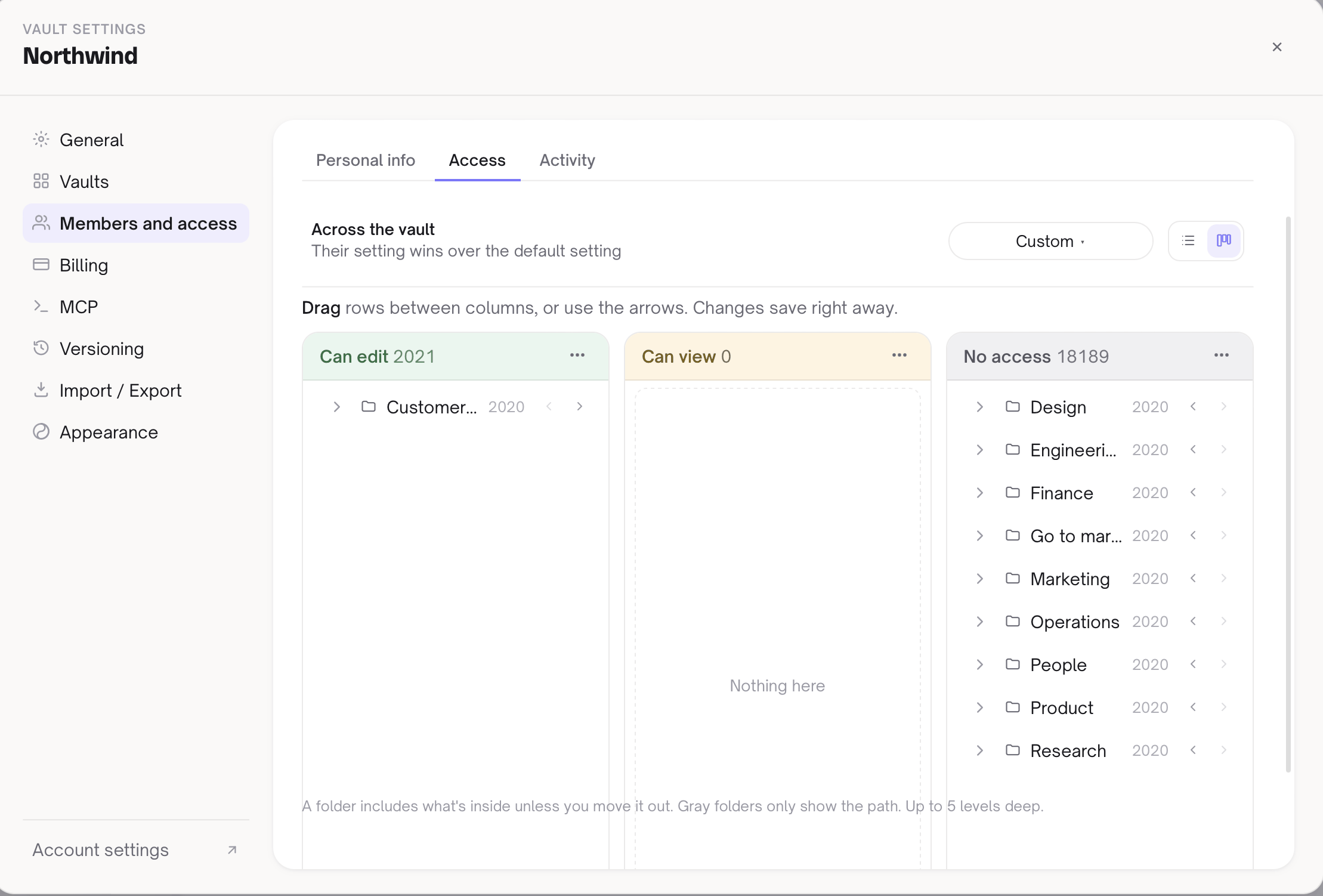
Your inbox, your skills and your schedule stay yours. Keep your personal CLAUDE.md, keep your slash commands, and point the agent at the shared vault for anything the team needs to read. The core is open source under Apache-2.0 and can be self-hosted, so the files stay yours.
Where does a shared vault not help?
- It does not write your skills. The jobs that make a second brain OS feel alive, the ingest command, the contradiction check, the nightly tidy, are still yours to write and run. Baalda gives them a place to write to, not the logic.
- It does not schedule anything. Hooks and crons run on your machine or your CI, the same as before.
- It does not fix a messy vault. A shared folder full of unlinked notes is a shared mess. The undefined-ui rule, nothing goes in until it is linked, is worth copying whatever tool you use.
- For one person, it is optional. If nobody else will ever read your notes, a local Obsidian vault with Claude Code is a complete second brain OS. Baalda earns its place the day a second person, or a second person's agent, needs the same notes.