
Short answer
An organizational second brain is a shared, written store of an organization's decisions, positions and procedures that people and AI agents both read and keep current. Meta's September 2026 design keeps it in typed text files linked both ways, with agents proposing changes and domain experts approving them. Any team can copy that shape.
An organizational second brain is a shared, written store of what an organization knows (its decisions, positions, procedures and the reasons behind them) that people and AI agents both read and keep current. It is the personal second brain idea moved up a level: the notes outlive any one employee, and no single person owns the whole thing.
The term got a concrete reference design on 2 September 2026, when Meta Engineering published "An Organizational Second Brain: Building an AI That Learns From Experts". The useful part is not that Meta built one. It is how: plain text files, not a search index and not a fine-tuned model. That choice is the one most organizations can copy, and it is the one this post is about.
What is an organizational second brain?
A personal second brain, in Tiago Forte's sense, is where one person keeps what they would otherwise have to remember. An organizational second brain has the same job for a group of people who change over time. Three things separate it from the personal version.
- Nobody owns all of it. Finance writes the finance pages, the support lead writes the escalation rules. The store is a set of areas with different owners.
- The readers change. Most people reading a page in two years did not work there when it was written. The page has to carry its reasoning, not just its conclusion.
- Agents read it and write to it. In 2026 the biggest reader is often an AI agent working on someone's behalf. It needs the same answers a new hire needs, and it can propose changes as well as consume them.
It overlaps with a company brain, which is the buying question (an index over your apps, or written pages you own). The organizational second brain is the written kind, and the question here is how to structure and maintain it once you have decided to write things down.
What did Meta's organizational second brain actually build?
Meta's post describes an agent for one compliance domain, where the same kinds of question come up across hundreds of product reviews. The authors (Shaurya Sengar, Jason Nawrocki, Jay Shah and Prashant Kommireddi) say the pattern carries over to finance, security and engineering. The design has four parts worth taking.
- Knowledge lives in text files. The stated principle is to "keep the complexity in text files that are readable by both humans and agents, rather than fine-tuned model weights." The domain came to more than 200 files in a strict taxonomy.
- The files have types. Position files hold the organization's stance on a question, with its constraints and boundaries. Taxonomy files are the glossary, "a single source of truth" for terms. Routing indexes say which files apply to which kind of question, "without relying on embedding similarity alone." Gateway files hold the threshold tests that decide whether a question enters a domain at all.
- Links run both ways. Every file declares
depends_onandreferenced_byin its frontmatter, which gives the store a "bidirectional dependency graph." Change a position and you can see everything that leans on it. - Changes are reviewed by the people who know. When the agent gets something wrong, an improvement loop works out whether the cause was missing knowledge or a bad procedure, drafts the fix, has a second agent in a fresh context review the diff, replays the failed case, and hands a domain expert "a pull request (diff) with a complete audit trail." In Meta's words, "A human expert reviews a proven fix rather than debugging a raw failure."
The results they report are qualitative: subject-matter experts found the outputs "useful almost all the time", assessments went from "days to minutes", and moving to targeted, staged reading cut tokens per turn by "around 80%".
Why files and not a search index?
Meta's answer is about reasoning, not storage. An agent that only retrieves chunks of raw material "has to re-derive that reasoning from raw sources on every run, which is slow, error-prone, and inconsistent." A position file states the conclusion once, with its conditions, so every run starts from the settled answer.
They did not drop retrieval. They split on "information density and expected usage frequency": the dense, often-used material is written up as files, and the long tail stays in a retrieval system. That is the same split Andrej Karpathy describes in his LLM wiki pattern, which Meta's post cites, and which the Karpathy LLM wiki post covers. Second brain vs RAG is the longer version of when each one earns its place.
The second reason is control. Text files are, as Meta puts it, "version-controlled, diffable, and reversible." You can read what the agent believes, see who changed it, and undo the change. You cannot do any of that to a weight.
How do you build an organizational second brain without Meta's pipeline?
Most organizations do not have a team to build a Git-based review flywheel with linters, replay and regression suites. What they can copy is the shape: typed text files, links both ways, an owner per area, and every change visible and reversible. Here is how that maps onto Baalda, which is the tool we build, and where it falls short of Meta's setup.
Baalda is a team second brain made of plain markdown files on your own disk, with real-time multi-user editing, and AI agents reading and writing the same files over MCP. The code is open source under Apache-2.0 and the server can be self-hosted.
One folder per area, owned by the people who know it. Access is set per folder or per file: Can edit, Can view or No access, for the whole team or for named people. Folder grants are inherited. So Finance/ can be Can view for everyone and Can edit for the finance team, and the same pattern repeats for Legal/, Support/ and Product/. That is the organizational version of "nobody owns all of it", enforced by the server rather than by convention.
Typed pages are just folders and frontmatter. Nothing stops you copying Meta's types directly:
Positions/
  refunds-over-30-days.md
  data-retention-eu.md
Glossary/
  terms.md
Routing/
  which-policy-applies.md
Procedures/
  review-a-new-vendor.md
Links run both ways without anyone maintaining them. A wikilink such as [[refunds-over-30-days]] in a procedure creates a backlink on the position page, and the graph view draws the whole map. That gives you Meta's referenced_by for free: open a position and the right panel lists every page that relies on it.
Agents work inside the same access rules. A local agent such as Claude Code edits the files on disk directly. A cloud agent connects to the server's MCP endpoint with a token tied to one person, set up as in the MCP setup guide, and gets tools such as search_notes, read_note and edit_note. Because the token belongs to a person, the agent can only edit the folders that person can edit. An agent working for support cannot rewrite a finance position.
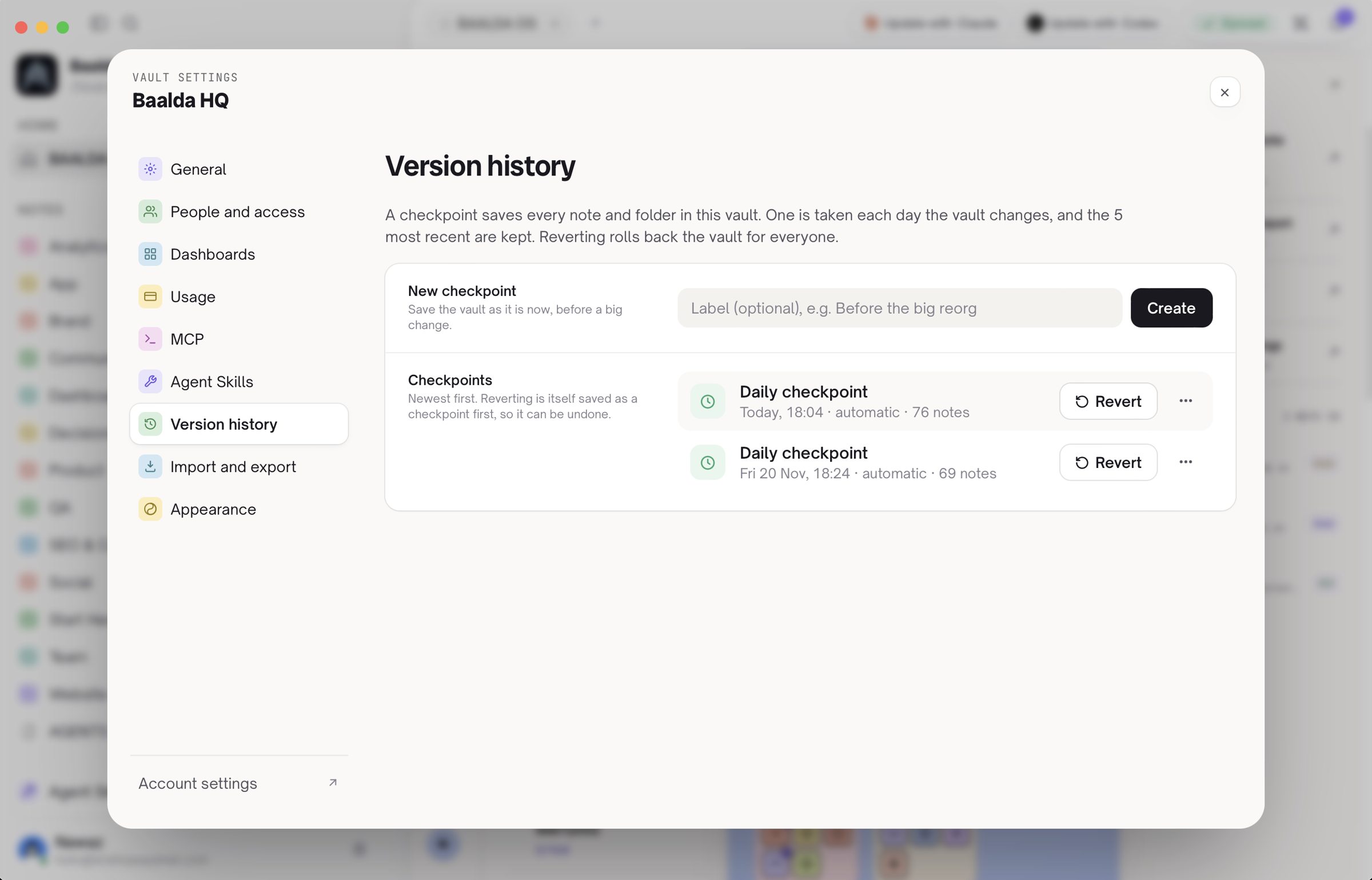
Every change can be seen and undone. Each note has version history in the right panel, and restoring an earlier version is itself an edit, so it can be undone too. When a single edit removes most of a note, the server first keeps the note as it was, labelled Before large deletion, which is the safety net for an agent that overwrites a page it should have appended to. Above the per-note history sit vault checkpoints: one taken automatically each day the vault changes, the five most recent kept, plus any you label yourself before a big reorganisation.
Who should be allowed to change an organizational second brain?
This is the decision that makes or breaks the thing, and Meta's answer is a good default: the agent may propose, an expert decides. Their post recommends a human in the loop "by default" for compliance, financial risk, security review and engineering safety.
A workable version for a smaller organization:
| Page type | Who reads | Who edits | What an agent may do |
|---|---|---|---|
| Positions | Everyone | The owning team | Draft into a proposals folder |
| Glossary | Everyone | One named owner | Suggest terms in a proposals folder |
| Procedures | Everyone | The owning team | Edit, reviewed in version history |
| Meeting notes, working pages | The team | The team | Write freely |
The folder layout does the enforcing. Put a Proposals/ folder where agents have Can edit and the owners review, keep Positions/ at Can view for everyone outside the owning team, and the people whose agents draft proposals cannot overwrite a position by accident.
Where Baalda falls short of Meta's design
Be clear about the gap, because it is real.
- No approval gate. Meta's changes arrive as pull requests that an expert approves before they land. In Baalda an edit by someone with Can edit lands live and is reviewed after the fact in version history. The proposals folder is a convention you set up with permissions, not a built-in review queue.
- No evaluation loop. Meta replays failed cases, runs a blind judge and keeps a regression suite so fixes do not break old answers. Baalda has none of that. If you need it, you build it around the files.
- No dependency linter. Backlinks show you what references a page. Nothing checks for broken references, size budgets or cycles the way Meta's linter does.
- It does not pull from your other tools. There are no connectors to Slack, email or Drive. Nothing enters the store unless a person or an agent writes it there.
What you get in exchange is the part Meta says matters most, and that most organizations skip: the knowledge sits in text files that people and agents can both read, that the organization holds on its own disks, and that every owner can correct. The rest of Meta's pipeline can be added around files. It cannot be added around a store you cannot read.